
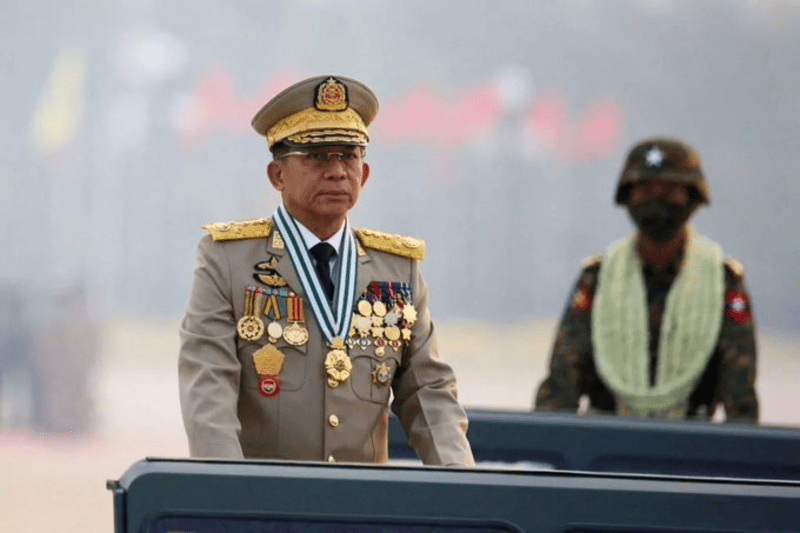
When Min Aung Hlaing seized power in Myanmar in 2021, the move was abrupt, direct, and unmistakably military. Five years on, his elevation to the presidency reflects a shift in structure, but not in control.
The parliamentary vote that confirmed him as president formalizes what has long been the political reality in Myanmar. The military remains firmly at the center of power, even as governance transitions into a nominally civilian framework.
The process has been presented as a step toward institutional normalcy. In practice, it represents a recalibration of authority rather than a redistribution of it. By moving into the presidency, Hlaing consolidates his position within a constitutional structure, while the military continues to operate through aligned leadership and entrenched influence.
The transition comes at a time when Myanmar remains deeply fractured. Since the coup that removed the elected government of Aung San Suu Kyi, the country has been locked in a prolonged and complex conflict. Armed resistance groups, ethnic militias, and military forces continue to clash across multiple regions, leaving large parts of the country unstable.
Against this backdrop, the shift in title does little to change the underlying dynamics. Power remains concentrated, opposition remains fragmented, and the conditions for political reconciliation remain distant.
For the economy, the implications are equally constrained. Myanmar has faced years of disruption, with foreign investment declining, supply chains weakening, and sanctions limiting access to global markets. The formalization of leadership may provide a clearer administrative structure, but it does not resolve the factors that have weighed on economic activity since 2021.
Investor sentiment, in particular, is unlikely to shift meaningfully. Political risk remains elevated, and the absence of a credible pathway toward stability continues to deter long-term capital.
Regionally, the development adds another layer of complexity. Southeast Asian nations have sought to balance engagement with caution, navigating the tension between maintaining dialogue and responding to ongoing instability. For Western governments, scrutiny is expected to persist, particularly regarding governance and human rights.
What emerges is a political transition that changes the optics more than the substance. Myanmar’s leadership now carries the formal trappings of a civilian government, but the underlying architecture of power remains anchored in the military.
The evolution reflects a broader pattern observed in other contexts, in which authority adapts its form to reinforce its continuity. In Myanmar’s case, the presidency becomes less a symbol of political change and more an extension of an existing order.
As the country moves forward, the central question is not who holds office, but whether the system itself is capable of accommodating change. For now, the answer appears uncertain.