

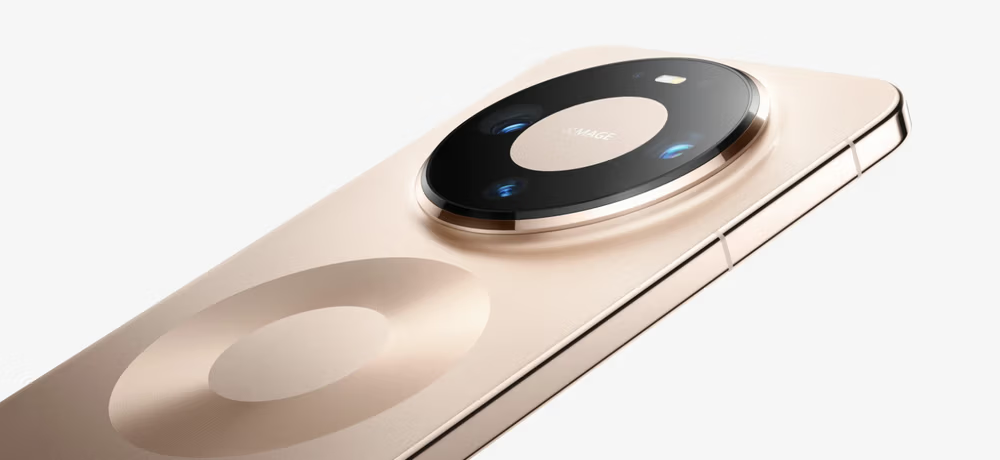
Huawei is leaning further into imaging with its latest flagship, positioning the Mate 80 Pro less as an incremental upgrade and more as a refinement of how smartphones capture the world.
At the center of the device is what the company calls a “True-to-Color Camera System”, designed to reduce the gap between what the eye sees and what the camera records. The focus is on consistency across lighting conditions, from low-light environments to high-contrast outdoor scenes, where color accuracy has traditionally been difficult to maintain.
The hardware reflects that direction. The phone features a triple-camera setup, led by a 50MP main sensor, supported by a 48MP telephoto macro lens with 4x optical zoom, and a 40MP ultra-wide camera. Together, they are designed to offer flexibility across shooting scenarios, from close-up detail to wide landscapes.
What Huawei appears to be emphasizing this time is not just resolution, but how images are processed.
Upgrades to pixel size, now increased to 2.45 micrometers, aim to improve light capture, particularly in darker environments. The addition of DCG HDR technology is intended to preserve detail in both highlights and shadows, while a revised spectral sensing system improves color precision, especially in more saturated scenes.
These hardware changes are backed by software. The device runs on a new-generation image signal processor, combined with what Huawei describes as a “True-to-Color Engine”, allowing for real-time HDR processing and more consistent color reproduction across different lenses.
The idea is continuity. Whether switching between cameras or shooting across different lighting conditions, the output is meant to remain visually consistent, avoiding the shifts in tone and color that often occur on multi-lens systems.
Huawei’s broader strategy is visible in that approach. Rather than competing purely on specifications, the company is pushing toward a more integrated imaging experience, combining sensor improvements with AI-driven processing.
The Mate 80 Pro, in that sense, is less about adding new features and more about refining existing ones, particularly in areas where smartphone photography still struggles to match human perception.
For users, the promise is straightforward. Images that look closer to what was actually seen at the moment of capture, rather than what the software decides to enhance.
Whether that translates into a meaningful shift in everyday photography will depend on how the device performs outside controlled conditions. But the direction is clear, Huawei is betting that accuracy, not exaggeration, is the next step in smartphone imaging.