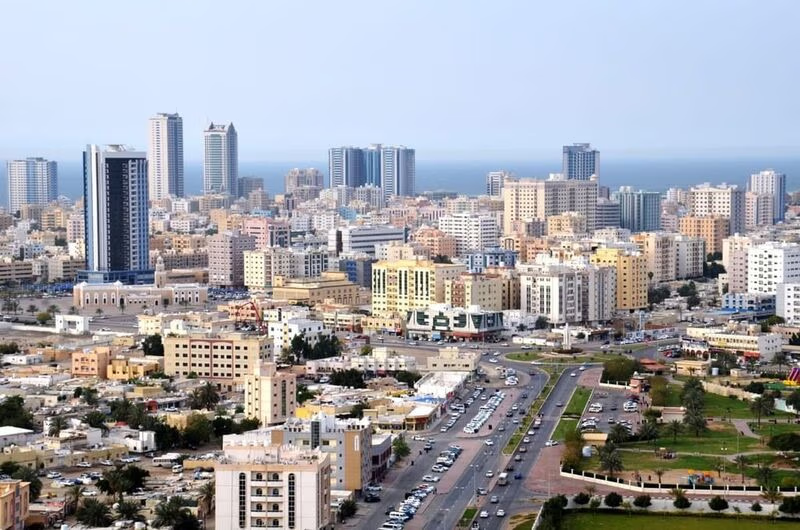
Ajman real estate transactions totaled AED1.66 billion in March, reflecting a market that continues to expand at a steady pace, supported by consistent demand across residential and industrial segments. Data released by the Ajman Department of Land and Real Estate Regulation showed that 938 transactions were recorded in March, underscoring the emirate’s position as a value-driven alternative in the UAE’s property landscape.
Officials say the figures point to a stable market environment. Eng. Omar bin Omair Al Muhairi, Director-General of the department, said the latest data reflects continued positive performance, even as buyers remain selective and pricing dynamics across the UAE evolve.
Much of the activity remains concentrated in the mid-market segment, which has long been Ajman’s core strength. Of the total, 680 transactions accounted for AED 1.2 billion in trading value, suggesting that demand remains driven by buyers seeking affordability and yield rather than speculative gains. The Al Amerah area recorded the highest individual sale value at AED185 million, highlighting that larger deals are still taking place alongside steady mid-sized transactions.
Ajman’s relative affordability compared with neighboring Dubai and Sharjah continues to shape buyer behavior. Investors and end-users priced out of larger markets are increasingly turning to Ajman, drawn by lower entry costs and the prospect of stable rental returns. This positioning has allowed the emirate to maintain consistent transaction volumes without the volatility seen in more premium markets.
Financing activity has also remained supportive. The market recorded 168 mortgage transactions worth AED 305 million during the month, indicating that liquidity remains available to both individual buyers and investors. The highest mortgage value, AED24.4 million, was recorded in Al Jurf Industrial 3, pointing to ongoing interest in industrial assets alongside residential properties, particularly as logistics and warehousing demand continues to grow.
Transaction patterns across locations further reinforce the market’s steady profile. Emirates City emerged as the most actively traded major development, followed by City Towers and Ajman One, all of which benefit from established infrastructure and relatively accessible pricing. Among the districts, Al Helio 2 led activity, followed by Al Zahia and Al Helio 1, suggesting that newer residential areas continue to attract buyers as supply expands.
Taken together, the data present a picture of a market defined less by rapid price surges and more by consistency. Ajman’s growth has been gradual, supported by affordability, improving connectivity, and spillover demand from neighboring emirates. For investors, the appeal lies in predictable returns rather than short-term gains, a dynamic that appears to be holding as the market moves further into 2026.