
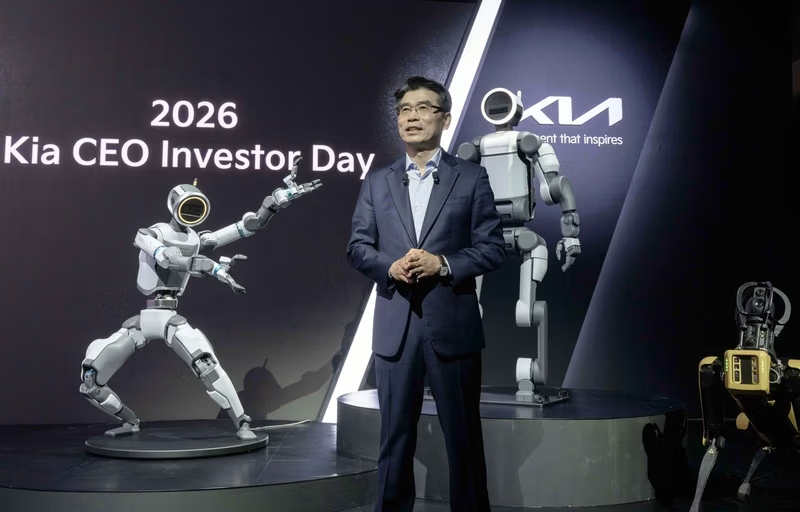
Kia’s 2030 strategy signals an aggressive growth and transformation roadmap, as Kia Corporation outlined plans to scale electrification, autonomous driving, and future mobility businesses at its 2026 CEO Investor Day.
The company is targeting global sales of 4.13 million units annually by 2030, up from a planned 3.35 million units in 2026, alongside a market share goal of 4.5 percent.
“EVs, HEVs, autonomous driving, and robotics will serve as key drivers for Kia’s fastest growth to date,” said Ho Sung Song, President and CEO of Kia, highlighting the pillars of the company’s next phase of expansion.
As part of its electrification push, Kia plans to expand its EV lineup to 14 models and target annual EV sales of 1 million units by 2030. In parallel, hybrid vehicles will remain a core growth driver, with the company aiming to sell 1.1 million HEVs annually by the end of the decade.
The strategy reflects a dual-track approach, balancing electrification with continued investment in internal combustion and hybrid vehicles to address varying adoption rates across global markets.
Kia is also scaling its Platform Beyond Vehicle (PBV) business, targeting annual sales of 232,000 units by 2030 through models such as PV5, PV7, and PV9. The segment is positioned to capture demand in the light commercial vehicle market through customizable, purpose-built mobility solutions.
Regionally, the company is focusing on differentiated growth strategies. It aims to achieve annual sales of 1.02 million units in the United States, 746,000 units in Europe, and 1.48 million units across emerging markets by 2030, with India identified as a key contributor.
Beyond vehicles, Kia is accelerating its push into software-defined vehicles and autonomous driving. The company plans to complete development of its first SDV model by 2027, followed by the rollout of Level 2++ autonomous driving capabilities from 2029.
The roadmap also includes investments in robotics and manufacturing innovation. Kia will deploy advanced robotics systems, such as Atlas, in its production facilities starting in 2028 to improve efficiency, safety, and productivity.
Financially, the company has committed to investing KRW 49 trillion between 2026 and 2030, including KRW 21 trillion allocated to future technologies such as electrification, autonomous systems, and robotics.
By 2030, Kia is targeting revenue of KRW 170 trillion, an operating profit margin of 10 percent, and operating profit of KRW 17 trillion, underlining confidence in its long-term transformation strategy.
The plan builds on Kia’s “Total Transformation” initiative launched in 2021, as the company seeks to reposition itself from a traditional automaker to a broader mobility solutions provider.