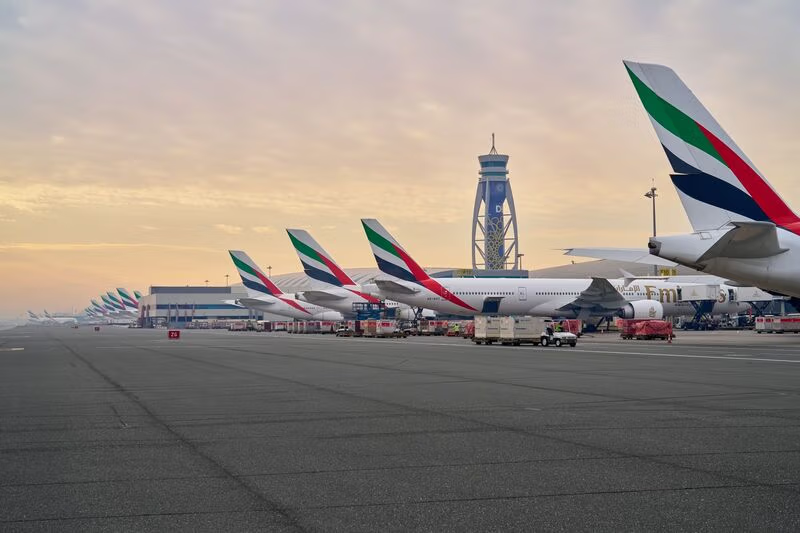
Dubai International Airport (DXB) has demonstrated operational resilience amid regional disruption, maintaining global connectivity while preparing to scale up capacity as airspace conditions stabilize.
Despite significant constraints across key regional air corridors, DXB remained fully operational, supporting the movement of 6 million passengers, over 32,000 aircraft movements, and 213,000 tonnes of cargo between late February and the end of April.
The disruption, which began on February 28 and intensified through March, placed considerable pressure on flight schedules and routing. However, coordinated decision-making across Dubai’s aviation ecosystem enabled the airport to maintain safe, consistent operations amid rapidly changing conditions.
With UAE airspace now fully restored, Dubai Airports has entered a recovery phase, increasing flight movements and enabling airlines to progressively rebuild schedules. Capacity expansion remains closely tied to the availability of regional flight paths and to continued coordination across neighboring airspace.
This recovery effort is being supported by collaboration across the oneDXB network, including key carriers such as Emirates and flydubai, as well as service providers and aviation authorities.
“The extraordinary events of the past few weeks are unprecedented for any major airport hub such as DXB,” said Paul Griffiths. “Maintaining smooth operations is critical to keep global journeys moving.”
DXB’s strategic importance is underscored by its role in international transfer traffic. The Middle East accounts for a significant share of global transit passengers, with DXB alone handling around 32 percent of this traffic. As conditions stabilize, this segment is expected to recover quickly, supported by strong underlying demand.
However, the disruption has had a measurable impact on performance. The airport handled 18.6 million passengers in the first quarter of 2026, down 20.6 percent year-on-year, while March traffic declined sharply to 2.5 million passengers. Cargo volumes also fell 22.7 percent to 399,600 tonnes during the quarter.
Key markets remained resilient, with India retaining its position as the largest source market, followed by Saudi Arabia, the UK, and Pakistan. London remained the busiest destination city, underscoring the strength of long-haul connectivity.
Operational performance metrics remained competitive despite the disruption. DXB processed 17.6 million bags during the quarter, with a mishandled baggage rate of 3.5 per 1,000 passengers, well below the global average of 6.3.
Looking ahead, Dubai Airports expects a strong rebound in travel demand as capacity constraints ease. The airport is actively working to unlock additional flight movements while aligning operations with evolving regional conditions.
At the same time, long-term expansion plans at Al Maktoum International Airport (DWC) continue to progress, reinforcing Dubai’s ambition to strengthen its position as a leading global aviation hub.
With inputs from WAM