
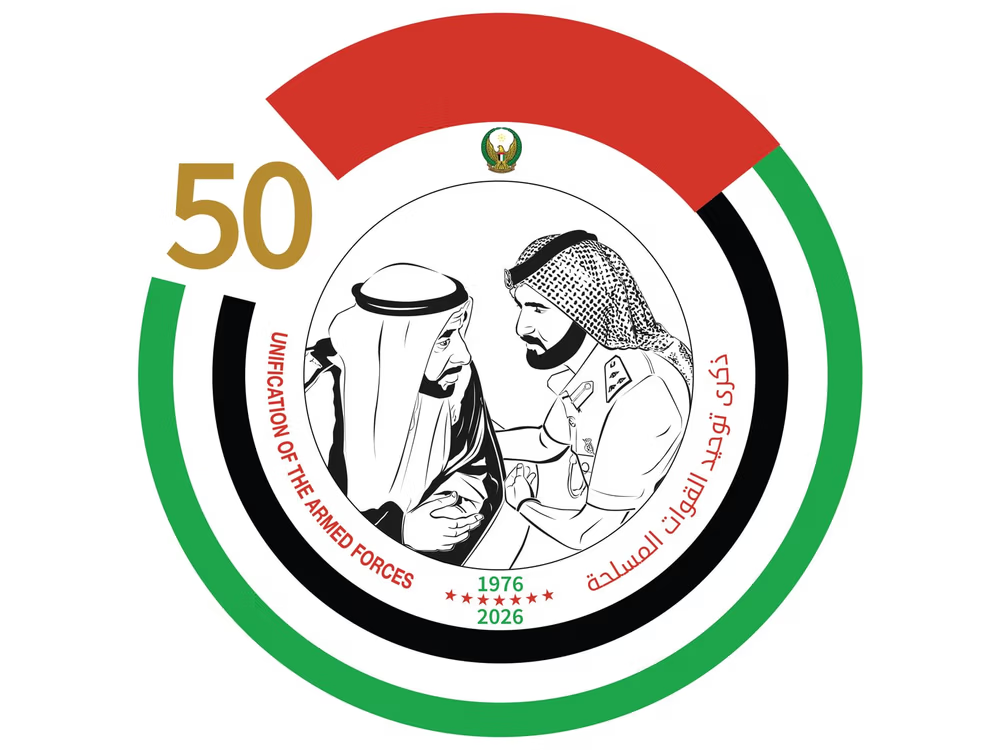
The United Arab Emirates Armed Forces will mark on Wednesday the 50th anniversary of their unification, a milestone that reflects five decades of institutional development, operational readiness, and a central role in safeguarding national sovereignty.
The anniversary comes at a time when the Armed Forces have demonstrated heightened operational capability, including intercepting ballistic missiles and drones in response to recent regional tensions. The performance underscores the military’s growing sophistication and its ability to respond to evolving security challenges.
Since their unification in 1976, the UAE Armed Forces have transformed into a modern, integrated defence institution built around a multi-domain strategy encompassing land, air, naval, and cyber capabilities. This approach reflects a shift toward coordinated operations, supported by advanced command-and-control systems and real-time intelligence sharing.
Land forces remain the backbone of the UAE’s defence structure, increasingly centred on mobility and precision. Modern armoured units, advanced artillery systems, and reconnaissance capabilities are now interconnected through digital networks, enabling faster decision-making and enhanced battlefield coordination.
Air power continues to play a decisive role in the UAE’s deterrence strategy. The country’s air force operates multi-role aircraft capable of long-range missions, supported by integrated air defence systems, early warning networks, and advanced command centres. Joint training exercises with international partners have further strengthened operational readiness and pilot capabilities.
Maritime security has also gained prominence, given the UAE’s proximity to key global shipping routes. Naval forces have expanded their capabilities through the deployment of multi-role vessels, coastal monitoring systems, and unmanned platforms designed to protect trade flows and energy corridors.
A significant shift in recent years has been the expansion of domestic defence industries. The UAE has moved beyond traditional procurement models to become an active participant in the design and production of advanced military technologies, aligning defence capability with broader economic diversification goals.
Despite rapid technological advancement, the UAE continues to place strong emphasis on human capital. Investment in military education, specialised training programmes, and international partnerships has been central to building a highly skilled force.
National service has further reinforced this approach, integrating the Armed Forces more closely with society and strengthening a culture of preparedness. The programme has broadened participation and contributed to shaping a new generation of trained personnel.
Women have played an increasingly prominent role within the military framework. Institutions such as the Khawla bint Al Azwar Military School have supported the development of female personnel, while voluntary national service for women has seen participation exceed 11 percent in some cohorts.
Beyond defence, the UAE Armed Forces have also been active in humanitarian and relief operations, contributing to emergency response efforts and international aid missions. These initiatives reflect the country’s broader commitment to stability and humanitarian engagement.
As the UAE marks 50 years since unification, the Armed Forces stand as a cornerstone of national security, shaped by a strategy that combines technological advancement, operational integration, and sustained investment in people.
With inputs from WAM