

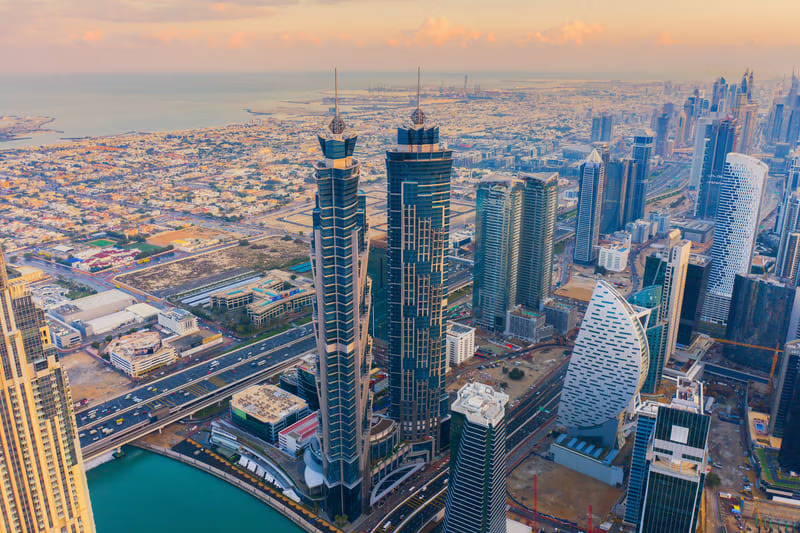
Dubai office market 2026 continues to strengthen, with values rising sharply across key districts as investors and occupiers focus on high-quality, income-generating assets, according to new data from Knight Frank.
Average office sales prices in Downtown Dubai climbed 29 percent year-on-year in 2025 to AED 5,130 per square foot, underscoring sustained demand for premium commercial space. The rise was supported by a surge in high-value deals, with 167 transactions above AED 10 million recorded during the year, marking a 114 percent increase and highlighting strong capital inflows into the sector.
“Dubai’s office market has firmly established itself as one of the most dynamic and resilient in the region, with investors increasingly focused on well-located, income-generating assets,” said Faisal Durrani, Partner – Head of Research, MENA. “The near-tripling in AED 10 million+ transactions between 2023 and 2025 underscores the depth of capital targeting Dubai and reflects a strong belief in the city’s long-term economic and real estate fundamentals.”
Demand remains anchored in the banking, financial services, and technology sectors, which together accounted for more than half of all new office space requirements in the second half of 2025. Banking and finance contributed 32.5 percent of demand, while the technology sector accounted for 23.1 percent, reinforcing the importance of these industries in shaping Dubai’s commercial real estate landscape.
“As we approach the end of the first quarter of 2026, the fundamentals of Dubai’s office market remain firmly intact. Assets are operating at or near full occupancy with very limited vacancy and, as demand continues to outpace supply, both capital values and rents have naturally increased quarter-on-quarter and year-on-year, a trend that has persisted since 2020,” said Adam Wynne, Partner – Head of Commercial Agency, UAE.
Occupier preferences are also evolving, with businesses increasingly prioritizing Grade A office space in prime locations. Access to infrastructure, including metro connectivity and surrounding amenities, continues to command a premium. Flexible working trends are further shaping demand, with companies viewing office space as a strategic tool for talent attraction and brand positioning.
“The diverse sectoral demand mix is reinforcing the shift towards high-quality, efficiently designed space that can support talent attraction, client engagement, and modern workplace strategies. The emphasis on grade-A buildings is also sharpening the divide between new and older stock, with well-specified developments in key locations emerging as clear beneficiaries of current demand dynamics,” Durrani added.
Looking ahead, a significant pipeline of new supply is expected to influence market dynamics. Around 24.2 million square feet of office space is scheduled for delivery between 2026 and 2030, largely concentrated in core districts such as Business Bay, Meydan, DIFC, and Jumeirah Lake Towers.
Within this pipeline, the Dubai International Financial Center remains central, with approximately 7.7 million square feet planned through to 2040, reinforcing its status as the region’s leading financial hub. Much of this development is build-to-rent, catering to financial and professional services firms.
Business Bay is emerging as a key investment destination, with a fully built-to-sell pipeline offering investors exposure to one of Dubai’s most active commercial districts, supported by strong connectivity and proximity to Downtown Dubai.
“Looking ahead, we do not anticipate any significant shift in market dynamics in the short term until the next wave of supply outlined in this report hands over. When it does, we expect a greater disparity to follow between Grade-A rents and secondary assets. Blue-chip occupiers remain focused on well-managed, single-owned buildings rather than strata or multi-owned stock, and while a significant volume of supply is scheduled through to 2030, only a proportion of this is single-owned, especially outside of the free zones,” Wynne added.
Emerging areas such as Za’abeel are also gaining traction, offering a balance between accessibility and value as the city’s commercial footprint expands.
For now, strong demand, limited vacancy, and sustained investor interest continue to underpin Dubai’s office market, even as the next wave of supply is set to shape its medium-term trajectory.